
The best pc sound cards for high impedance headphones are the ones whose headphone amp is built for 250 to 600 ohm models, which onboard audio often cannot drive well. This guide compares seven cards and interfaces by the amp ranges their makers publish, and says plainly where a spec is missing.
Quick verdict on the best pc sound cards for high impedance headphones
Impedance tells you how much voltage a headphone needs, not how good it sounds. We ranked these products by what the manufacturer states about headphone support, then by availability, because several of the strongest Creative cards are shown as out of stock or winding down on Creative’s own store.
- Best amp range on a card: Creative Sound Blaster AE-9 (16 to 600 ohm)
- Best available internal card: Creative Sound Blaster AE-7, approx. $229.99 on Amazon (Nov 11, 2026)
- Best value internal card: Creative Sound BlasterX AE-5 Plus
- Cheapest 600 ohm card: Creative Sound Blaster Z SE
- Best external option: Creative Sound BlasterX G6
- Best card with a swappable op-amp: ASUS Xonar AE
- Best music-focused option: Focusrite Scarlett 2i2 (4th Gen)
Quick comparison table
The table lists the headphone support each maker publishes. Amazon prices appear only where we had a listing, and the other rows say so. Maximum impedance shows what the amp is rated to drive, which is not the same as how loud or clean a specific headphone will sound.
| Product | Type | Published headphone support | Approx. price (Nov 11, 2026) |
|---|---|---|---|
| Creative Sound Blaster AE-9 | Internal PCIe plus external module | 16 to 600 ohm, 1 ohm output impedance | No Amazon price in our data |
| Creative Sound Blaster AE-7 | Internal PCIe plus external module | 16 to 600 ohm, 1 ohm output impedance | $229.99 |
| Creative Sound BlasterX AE-5 Plus | Internal PCIe | Up to 600 ohm, 1 ohm output impedance | $104.99 |
| Creative Sound Blaster Z SE | Internal PCIe | Drives up to 600 ohm | $75.95 |
| Creative Sound BlasterX G6 | External USB | 16 to 600 ohm, 1 ohm output impedance | No Amazon price in our data |
| ASUS Xonar AE | Internal PCIe | 150 ohm headphone amp | No Amazon price in our data |
| Focusrite Scarlett 2i2 (4th Gen) | External USB interface | 115 dB at 300 ohm, 50 ohm output impedance | No Amazon price in our data |
How we chose these products
We did not test any of these products. We relied on manufacturer pages for Creative, ASUS and Focusrite, and on the November 11, 2026 Amazon listings for the prices and ratings we could find, then dropped cards that publish no headphone drive information at all.
That rule excluded most no-name PCIe cards and USB adapters, whose listings rarely state any impedance range. Where Creative’s page was unavailable we left the value out instead of copying a secondary source, and we mark availability problems clearly so you do not chase a card you cannot buy.
Best pc sound cards for high impedance headphones compared in detail
Each entry explains the published amp specs, where the card runs into trouble and who should buy it. Because some of these products are hard to find new, treat the list as a map of what the market has offered rather than a guaranteed shopping list, and check stock before you plan a build.
Creative Sound Blaster AE-9: best amp range on a card
The AE-9 has the most complete high impedance story of any card here. Creative lists a discrete Xamp bi-amp headphone stage with 1 ohm output impedance, support for 16 to 600 ohm headphones and a high-gain mode for 150 to 600 ohm models, plus a 129 dB dynamic range on the DAC side.
It pairs an internal PCIe card with an external control module that has 3.5 mm and 6.3 mm headphone outputs, and Creative lists a 6-pin PCIe power connector and a 500 W minimum power supply. Creative’s page shows it out of stock, its software sits under archived products, and a 2024 kernel bug report said Linux produced no sound. It is Windows only.
- Buy if: you can find one new and want the fullest published amp.
- Skip if: you use Linux or cannot spare a power connector.
Creative Sound Blaster AE-7: best available internal card
The AE-7 shares the same Xamp amp specs as the AE-9 in Creative’s data, with 1 ohm output impedance and support for 16 to 600 ohm headphones. It adds a lower-cost route into that amp design for people who do not need the XLR microphone input that the flagship offers, which is the main difference.
Amazon showed approx. $229.99 on Amazon (Nov 11, 2026), with 4.4 stars from about 759 ratings. Creative lists a 127 dB dynamic range and Windows 8 through 11, and the product page showed Notify Me. Mainline Linux has a quirk for it, but feature completeness is unconfirmed, so do not assume full support.
- Buy if: you want the published 600 ohm amp at a lower price than the AE-9.
- Skip if: you need a guaranteed new-stock supply.
Creative Sound BlasterX AE-5 Plus: best value internal card
The AE-5 Plus keeps the Xamp amp and the 1 ohm output impedance in a cheaper card with RGB lighting, which makes it the most affordable way to reach Creative’s published 600 ohm class. Creative Asia lists a 122 dB dynamic range and a 32-bit/384 kHz playback mode.
Amazon showed approx. $104.99 on Amazon (Nov 11, 2026), with 4.4 stars from about 911 ratings. The exact DAC chip is unconfirmed, because Creative’s table and a parts listing disagree, and the card is shown as limited stock. It is a Windows card, though Linux has a partial kernel quirk.
- Buy if: you want the Xamp amp at around $100.
- Skip if: you want a clearly documented DAC chip.
Creative Sound Blaster Z SE: cheapest 600 ohm card
The Z SE is the cheapest route to a card that is stated to drive headphones up to 600 ohm. Creative lists an amplified 3.5 mm headphone output, a 116 dB signal-to-noise ratio and ASIO 2.0, though it does not publish the amp’s output impedance anywhere on the product page we read.
Amazon showed approx. $75.95 on Amazon (Nov 11, 2026), with 4.3 stars from about 993 ratings. Without an output impedance figure we cannot say how well it matches sensitive or low-impedance headphones, and Creative’s page showed Notify Me. It runs on Windows 8, 10 and 11 and has only a single 3.5 mm headphone jack.
- Buy if: you own 250 to 600 ohm headphones and want the lowest price.
- Skip if: you need a published output impedance.
Creative Sound BlasterX G6: best external option
The G6 is a USB-C DAC and amp that brings the same Xamp design to laptops, consoles and Macs. Creative lists a 130 dB dynamic range, a 1 ohm output impedance, 16 to 600 ohm support and 32-bit/384 kHz playback on Windows 10 and later, plus a combo optical input and output.
It is bus-powered, supports ASIO for playback and recording, and works with Windows and Mac OS X 10.8 and later, although the Sound Blaster Command software is Windows only. Creative’s US listing showed it out of stock, and we found no Amazon listing in our data, so check retailers for current availability and price.
- Buy if: you need a portable amp for a laptop or Mac.
- Skip if: you want a card that sits inside the PC.
ASUS Xonar AE: best card with a swappable op-amp
The Xonar AE uses an ESS ES9023P DAC and lists a 110 dB signal-to-noise ratio. ASUS describes a 150 ohm headphone amp with a swappable op-amp, which gives tinkerers a way to change the sound signature, and Sonic Studio software plus Windows 10 WHQL drivers come with it.
Its 150 ohm rating is lower than Creative’s 600 ohm class, so it suits mid-impedance studio headphones rather than the most demanding ones. B&H and Memory Express list it as discontinued even though the ASUS page remains online, so the official status is unconfirmed and used stock may be the realistic route.
- Buy if: you own 32 to 150 ohm headphones and want an adjustable amp.
- Skip if: you own 300 ohm or 600 ohm headphones.
Focusrite Scarlett 2i2 (4th Gen): best music-focused option
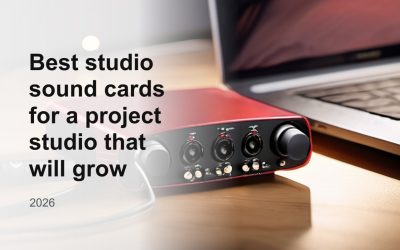
The Scarlett 2i2 is an audio interface, not a gaming sound card, but Focusrite publishes unusually detailed headphone numbers. It lists 112 dB at 33 ohm, 115 dB at 300 ohm and a 50 ohm output impedance, with 32 mW into 33 ohm and 22 mW into 300 ohm, which lets you compare it directly with other interfaces.
Focusrite says the output drives high impedance headphones louder than the previous generation, and the interface runs on Windows and macOS with a three-year warranty. Its 50 ohm output impedance is higher than Creative’s 1 ohm, which can matter for headphones with uneven impedance curves. Its product page showed sold out at fetch time, which may be temporary.
- Buy if: you also record microphones or instruments.
- Skip if: you want surround processing for gaming.
Buying guide for high impedance headphones
Matching an amp to a headphone is about voltage and current, so start with the headphone’s rated impedance and sensitivity. A pair rated at 250 ohm and 100 dB per milliwatt needs a very different amp than a 32 ohm gaming headset, and a spec sheet is the only reliable guide.
What impedance really means
Impedance, measured in ohms, is the resistance a headphone presents to the amp. Higher values generally need more voltage to reach a given volume, but they do not by themselves mean higher quality. Many 250 and 600 ohm studio headphones sound quiet from a phone or onboard jack.
Check the headphone’s sensitivity rating too, because efficient models are easier to drive at any impedance.
Output impedance and damping
The amp’s own output impedance affects how it interacts with the headphone, and a low figure usually keeps that interaction small. Creative’s Xamp cards list 1 ohm, which keeps the match close to ideal for most models. The Scarlett’s 50 ohm figure can shift the tonal balance of some headphones.
If your headphones have a flat impedance curve, either approach can work in practice.
How to choose the best pc sound cards for high impedance headphones
Start with your headphone ohms. Over 250 ohm points toward a Creative Xamp product or an interface with published power figures. Under 150 ohm, even the Xonar AE is enough. Then confirm that you can actually buy the card new, because availability is the weak point in this category.
Verify your operating system and a free power connector before ordering a PCIe card.
FAQ
These answers focus on the questions people ask before they spend money on a headphone amp. They are based on the manufacturer data summarized above, which describes what a product is designed to drive rather than how it sounds, so they cannot replace a listening comparison with your own headphones.
Do I need a sound card for 250 ohm headphones?
Not always. Some motherboards drive them acceptably, but many onboard outputs are quiet or noisy with demanding headphones. A dedicated amp makes the most difference when volume runs out or you hear noise. The gain is real but depends on your headphones and ears.
Is a higher signal-to-noise number better?
Only to a point, and not across brands. Makers measure differently, so 129 dB on the AE-9 and 120 dB on a USB DAC are not directly comparable. Beyond roughly 100 dB the difference is not audible in practice, so choose on amp range, driver support, ports and availability instead.
Can a USB DAC replace an internal sound card?
For headphones, often yes. A USB device such as the G6 provides the same Xamp stage without a PCIe slot and also works on laptops and Macs. Internal cards add optical outputs and speaker jacks, which matter if you connect a receiver or surround speakers.
Conclusion
If you can find one, the Creative Sound Blaster AE-7 or AE-5 Plus is the best fit for 250 to 600 ohm headphones, because Creative publishes a 1 ohm output impedance and a 600 ohm range. Pick the Z SE to spend less, the G6 for laptops, or the Scarlett 2i2 if you also record.
Write Your Review
No reviews yet. Be the first to share your experience!