
Searching for the best phase change CPU coolers turns up three different things: refrigerator-style units that chill a CPU below room temperature, heat pipe and vapor chamber coolers that use phase change inside, and phase-change thermal pads. This guide explains each, what you can buy in the US in November 2026, and which suits your build.
Quick verdict
True vapor-compression phase change coolers are a niche for extreme overclocking, with condensation risk, high cost and noise. For most people, the useful options are a heat pipe or vapor chamber air cooler, such as the Thermalright Phantom Spirit 120 SE, paired with a phase-change pad like Thermal Grizzly PhaseSheet PTM instead of paste.
| Option | How phase change is used | Below room temperature? | What you can buy | Best for | Amazon US price, Nov 2026 |
|---|---|---|---|---|---|
| — | — | — | — | — | — |
| Vapor-compression unit | Refrigerant evaporates at the CPU, compressor recycles it | Yes | Specialist builders, not in our Amazon data | Extreme overclocking | not listed |
| Heat pipe tower | Fluid boils at the base, condenses at the fins | No | Thermalright Phantom Spirit 120 SE | Everyday desktops | about $36 |
| Vapor chamber cooler | Same cycle in a flat chamber | No | CRYORIG C5 | Slim SFF builds | about $64 |
| Phase-change pad | Pad softens at operating temperature to fill gaps | No | Thermal Grizzly PhaseSheet PTM, PTM7950 pads | Replacing paste | about $14 to $17 |
| Peltier (TEC) cooler | Not phase change; electric heat pump | Can be | Niche products | Special cases only | not covered |
How we built this guide
This is a research-based guide, not a lab test. We used Wikipedia’s computer cooling article for how phase change, Peltier and liquid nitrogen cooling work, the CRYORIG and Thermalright product pages for cooler specs, and Amazon US data collected on November 11, 2026, including a search for phase-change thermal pads.
We did not find a vapor-compression CPU cooler in our Amazon US data, so we do not recommend a specific unit. Instead we explain what they involve, then focus on phase change products that are easy to buy and safe to run every day.
Product figures come from maker pages where available, otherwise from listings, and we flag claims we could not verify. Prices, ratings and review counts are an Amazon US snapshot from November 2026 and will change.
Ranking follows practicality, verified specs and value, never commission. Because this is a buying guide rather than a roundup, we cover four products in depth and explain the rest of the category.
Types of phase change CPU coolers explained
Phase change simply means a substance switching between liquid and gas, or between solid and soft, while absorbing or releasing heat. Each type below uses that idea differently, and the differences decide cost, noise, safety and whether the cooler can take your CPU below the temperature of the room.
True vapor-compression phase change cooling
This is what enthusiasts usually mean. Wikipedia describes the unit as typically sitting under the PC, with evaporation that can produce temperatures from about minus 15 to minus 150 degrees Celsius. It works like a refrigerator: refrigerant evaporates at the CPU, and a compressor and condenser recycle it.
The trade-offs are serious. Wikipedia notes these units are relatively expensive compared with an average desktop and generate significant noise because they are essentially refrigerators. Any surface below the dew point collects condensation, so everything near the socket must be insulated to keep water off the electronics.
- Sub-ambient temperatures for record overclocks
- Expensive, loud and power hungry
- Needs careful insulation against condensation
Heat pipes and vapor chambers
Almost every modern air cooler already uses phase change. Wikipedia explains that a heat pipe is a hollow tube holding a liquid that evaporates at the hot end, travels as vapor to the cooler end, condenses and gives up its heat, then returns by gravity or capillary action. A vapor chamber works the same way in a flat sheet.
These devices cannot cool below room temperature, but they move heat efficiently and silently, need no power beyond the fans, and are safe to run every day. That makes them the practical phase change cooler for nearly every build.
Phase-change thermal pads
Phase-change pads replace thermal paste between the CPU and cooler. Thermal Grizzly describes PhaseSheet PTM as a clean alternative to paste whose interface adapts during operation to support heat transfer. They do not cool on their own; they improve contact between your CPU and whatever cooler you use.
Peltier and liquid nitrogen, for comparison
Peltier (TEC) coolers are not phase change. Wikipedia says they are only about 10 to 15 percent as efficient as an ideal refrigerator and typically consume more power than the heat they move. Liquid nitrogen boils at minus 196 degrees Celsius and is used only for short benchmarking sessions, with real handling hazards.
Best phase change CPU coolers you can buy
The four products below are the practical phase change options for a normal desktop: two coolers that use evaporation and condensation internally, and two pads that replace paste. Each section covers who it suits, its verified specs and the trade-offs, so you can combine a cooler and a pad if you want.
Thermalright Phantom Spirit 120 SE
The Phantom Spirit 120 SE is the best everyday phase change cooler for most desktops. Its seven heat pipes run the evaporate-and-condense cycle described above, carrying heat to two towers of fins, and its two fans are capped at 1,500 RPM. It suits Core i5, Core i7, Ryzen 5 and Ryzen 7 builds.
Thermalright lists a 154mm height, seven 6mm heat pipes and TL-C12B V2 120mm fans at 1,500 RPM. The listing confirms two fans, 66.17 CFM and a noise level of 25.6 dB(A) or less, and describes Thermalright’s AGHP heat pipe technology as reducing the effect of mounting orientation on the pipes.
Sockets are LGA 1851, 1700, 1200 and 115x plus AM5 and AM4. It was listed around $36 on Amazon US and rated 4.8 out of 5 from about 1,000 ratings as of November 2026. Thermalright did not state a warranty on its page.
- Pro: seven heat pipes at a budget price
- Pro: quiet fan ceiling
- Con: no stated warranty
- Con: 154mm height needs a mid-tower
Buy if you want practical phase change cooling for a mainstream CPU. Skip if your case is compact.
CRYORIG C5
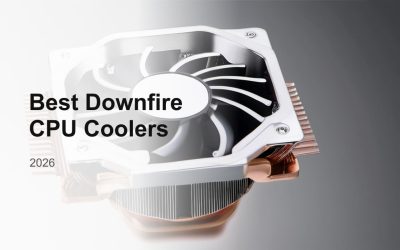
The CRYORIG C5 uses a vapor chamber base instead of heat pipes, which suits a short down-draft cooler where pipes have little room to bend. It suits slim small form factor builds with about 55mm to 60mm of clearance and 65W to mid-range desktop chips.
CRYORIG’s page lists 97 x 97 x 54.9mm including the fan, 61 fins, a nickel-plated vapor chamber base, a 165W rating and a 96.8 x 96.8 x 31.5mm fan at 3,200 RPM rated at 34.5 dB(A). The Amazon listing shows 3,400 RPM and 36.7 dB, which conflict with the maker figures. Sockets per the listing are AM5, AM4, LGA 1851, 1700, 1200 and 1150.
It was listed around $64 on Amazon US and rated 4.7 out of 5 from about 30 ratings as of November 2026.
- Pro: vapor chamber in a 54.9mm cooler
- Pro: 165W maker rating
- Con: fan is loud for its size
- Con: small ratings base
Buy if you want a vapor chamber cooler for a slim case. Skip if quiet operation matters most.
Thermal Grizzly PhaseSheet PTM
PhaseSheet PTM is the best phase-change pad for most builders. It comes from a well-known thermal paste maker and has the largest ratings base of the pads in our search. It suits anyone replacing paste on a CPU, GPU or console who wants a clean, non-spreading application.
The listing describes a 50 x 40mm phase-change pad that adapts during operation, can be cut to fit, and is electrically non-conductive, with model number TG-PS-50-40. It is marketed for CPU, GPU and console repasting. The listing does not give a thermal conductivity figure or phase-change temperature.
It was listed around $14 on Amazon US and rated 4.5 out of 5 from about 1,900 ratings as of November 2026, and its listing showed the top Best Sellers Rank in thermal pads.
- Pro: established brand and large ratings base
- Pro: non-conductive and cuttable
- Con: no conductivity figure on the listing
- Con: one 50 x 40mm sheet per pack
Buy if you want an easy, mess-free paste replacement. Skip if you need a published conductivity number.
PTM7950 40 x 80mm pad
Generic PTM7950 pads use a phase-change material that many builders know by that name. The 40 x 80mm sheet in our data is large enough for a desktop CPU with material left over. It suits builders who want a bigger sheet to cover several components or future repastes.
The listing title gives 40 x 80 x 0.25mm and names PTM7950 phase-change material. Another PTM7950 listing in the same search claims 8.5 W/mK, but these are seller figures we could not verify against the original manufacturer. Authenticity of generic PTM7950 is hard to confirm from a listing.
It was listed around $17 on Amazon US and rated 4.5 out of 5 from about 930 ratings as of November 2026.
- Pro: large sheet for several uses
- Pro: 0.25mm thickness stated
- Con: seller specs not verified
- Con: unbranded, authenticity uncertain
Buy if you want a larger sheet and accept a generic source. Skip if you prefer a known brand.
Choosing a phase change setup
The right choice depends on your goal. Most builders want lower temperatures and less maintenance, not record overclocks. These checks help you pick between a true phase change unit, a heat pipe or vapor chamber cooler, and a phase-change pad, and avoid the risks that come with sub-ambient cooling.
When the best phase change CPU coolers mean sub-ambient
Only vapor-compression units and liquid nitrogen take a CPU below room temperature. They make sense for competitive overclocking, where the extra cost, noise and insulation work are part of the hobby. For daily gaming or work, the condensation risk alone outweighs the benefit.
Matching a cooler to your CPU
Intel lists the Core i5-14400 at 148W and the Core i7-14700K at 253W maximum turbo power, while AMD rates the Ryzen 7 7800X3D at 120W. A seven-pipe tower like the Phantom Spirit suits chips up to about 180W. For 250W-class chips, a large dual tower or 360mm AIO is the practical step up.
Applying a phase-change pad
Clean the old paste fully, cut the pad to cover the heat spreader, peel both protective films and mount the cooler with normal pressure. Pads need heat to soften into place, so allow a warm-up period before judging temperatures, and follow the maker’s instructions for the first run.
FAQ
These answers cover common questions about phase change cooling. They draw on Wikipedia’s computer cooling article and the product pages and listings above rather than on our own testing, so they explain how each approach works and what it costs instead of quoting temperatures we did not measure.
Can I buy a phase change CPU cooler for a gaming PC?
Specialist vapor-compression units exist, but none appeared in our November 2026 Amazon US data, and Wikipedia notes they are expensive and noisy and need insulation against condensation. For a gaming PC, a heat pipe tower or AIO is far more practical and safer.
Is a phase-change pad better than thermal paste?
It is cleaner to apply and does not need spreading, and Thermal Grizzly markets PhaseSheet as a clean alternative to paste. We did not test it, and the listings we checked gave little performance data, so expect a convenience benefit first. A good paste applied correctly also works well.
Are heat pipe coolers really phase change coolers?
Yes. Wikipedia explains that a heat pipe’s liquid evaporates at the hot end and condenses at the cool end, which is a phase change cycle. The difference from refrigeration is that heat pipes cannot cool below room temperature, because they have no compressor.
Conclusion
For almost every build, the best phase change CPU cooler is a heat pipe tower like the Thermalright Phantom Spirit 120 SE, paired with Thermal Grizzly PhaseSheet PTM if you want a clean paste alternative. Choose the CRYORIG C5 for a slim case, and consider true vapor-compression cooling only for dedicated extreme overclocking.









Write Your Review
No reviews yet. Be the first to share your experience!