
Gaming desks come in more shapes than most people expect, and the right one depends on your room, your screens and how you play. This guide explains the best types of desks for gaming, what each style does well, where it falls short and which players it suits, using real Amazon listing specs as examples.
Short answer: which desk type suits most players
For most players, a straight rectangular desk around 47 to 55 inches wide is the best starting point, because it fits against any wall and holds one or two screens. L-shaped desks suit corners and multi-device setups, while electric standing desks suit people who also work at the same desk for long hours.
The other types solve narrower problems. Z-frame and A-frame gaming desks add gamer features such as RGB and hooks, hutch desks build storage upward, glass desks prioritize looks, compact desks fit tight rooms and lap desks serve couch or bed gaming. The sections below explain each one in turn.
Gaming desk types explained
Each desk type below is described by its shape, the typical sizes we see in current Amazon listings, its strengths, its trade-offs and the kind of player it suits. Example models and specs are taken from listings captured on November 10, 2026, and prices are approximate, so treat them as illustrations rather than recommendations.
Straight rectangular desks
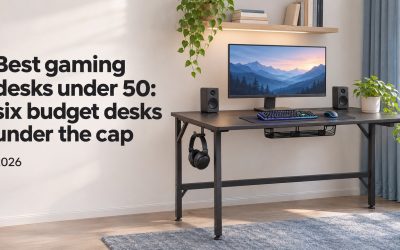
A straight rectangular desk is the most flexible type, because it fits against a flat wall, under a window or in the middle of a room. Listings in this group run from about 32 inches wide, like the SHW Mission, to 63 inches, like the Huuger 63 inch desk, and most are 19 to 24 inches deep.
Their strength is simplicity: an open top that takes any monitor, arm or mouse pad you choose. Their weakness is that they rarely include storage or power, so you add those yourself. They suit almost everyone, especially players who want a clean, adaptable surface.
L-shaped and corner desks
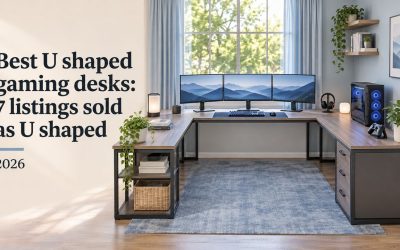
An L-shaped desk wraps around a corner, giving you two work surfaces at a right angle. Current listings range from compact corners such as the Bestier 42-inch L-shaped desk to long layouts such as the AODK 79 inch L-shaped desk, and many are reversible so the return can face left or right.
The extra wing is useful for a laptop, a console, a second monitor or work papers. The trade-off is that it needs a free corner and takes more floor area than a straight desk. L-shapes suit players who split time between gaming and work or who run more than one device.
Z-frame and A-frame gaming desks
Z-frame and A-frame desks are the classic gaming-styled tables, named after the shape of their steel legs. Examples include the HLDIRECT 63 inch Z-shaped desk and the HLDIRECT 55 inch A-shaped desk, which list carbon fiber surfaces, cup holders, headphone hooks and, on some models, app-controlled RGB lighting.
They bundle small gaming accessories into the desk itself, which saves money on extras. The trade-off is a bold look that may clash with other furniture, and the frame can limit where you put your legs. They suit dedicated gaming rooms and players who like a themed setup.
Electric standing desks
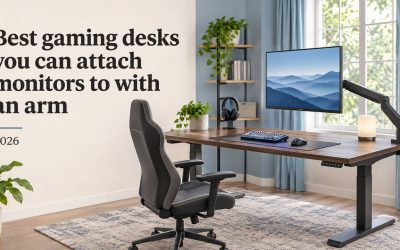
An electric standing desk uses a motor to raise and lower the top, so you can switch between sitting and standing. Listings such as the ErGear 48 x 24, the FLEXISPOT EN1 and the VIVO 83 x 30 cover sizes from about 47 to 83 inches wide, and many add memory presets.
The benefit is flexibility for long days that mix work and play. The costs are a higher price than most fixed desks, a heavier frame and cables that must move with the top. They suit remote workers who also game and players who want to change position during long sessions.
Hutch and storage desks
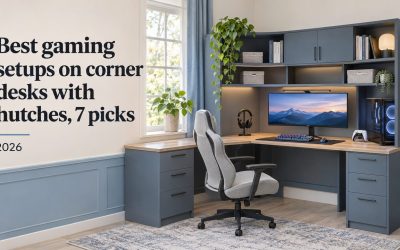
Hutch desks add shelves above the main surface, while storage desks add drawers or side shelves below it. Examples include the SEDETA 79 inch desk with a hutch, the Cyclysio 39 inch hutch desk and the Korfile 47 inch desk with five drawers, which also lists power outlets and LED lighting.
They help small rooms by moving speakers, books and gear off the desktop. The trade-off is that a hutch can limit tall monitors and arms, and drawers can cut into legroom. They suit players with lots of accessories, students and anyone who needs gaming and study storage in one piece.
Glass-top desks
Glass-top desks use tempered or standard glass as the surface, often on a metal frame. Listings include the EUREKA ERGONOMIC 43 inch RGB glass desk, the Flash Furniture glass L-shape desk and electric glass standing desks from Claiks and Marsail, which add drawers and, on the Claiks, USB ports.
Glass looks sleek and is easy to wipe clean, and some tops are writable. The drawbacks are fingerprints, a cold feel and mouse tracking that can suffer on bare glass, so a pad is usually needed. Glass desks suit players who prize a polished look and keep their setup tidy.
Compact and small desks
Compact desks are the narrowest and shallowest options, usually 40 inches wide or less. The Sweetcrispy 40-inch desk, the Lufeiya 40 inch desk and the SHW Mission 32-inch desk are examples, and some, like the Furinno EFFICIENT desk, add small side shelves for a console or books.
They fit bedrooms, dorms and apartments where a full desk would block the walkway. The trade-off is limited room for a second screen or a wide mouse sweep, and some list modest load ratings. They suit single-monitor setups, laptops and younger players with small rooms.
Lap desks for couch and bed gaming
Lap desks are not full desks but portable surfaces for a laptop or a mouse and keyboard on the couch or in bed. Examples include LAPGEAR lap desks with built-in mouse pads, HUANUO cushioned lap desks and the SAIJI X-Large laptop table, which has adjustable legs and a storage drawer.
They make living-room or bedroom gaming more comfortable without a permanent desk. Their limits are small surfaces and no space for a desktop monitor. They suit laptop players, handheld PC users and anyone who games away from a dedicated room.
How to choose the best types of desks for gaming for your setup
Picking a type is easier once you know three things: the space you have, the gear you run and how long you sit. Measure the wall or corner first, count your screens and devices, then decide whether you only game or also work at the desk, because each answer narrows the field.
Start with your room and wall space
A flat wall points to a straight or Z-frame desk, a free corner points to an L-shape, and a very small room points to a compact desk or a hutch desk that builds upward. Leave space behind the desk for your chair to roll back, and check doors, windows and radiators before you choose a size.
Count your screens and devices
One monitor fits on most desks from 40 inches up. Two monitors push you toward 55 inches or more, and three toward 63 inches or more, based on listing widths. A laptop, console or second PC beside the main screen is often easier on an L-shape, which gives each device its own surface.
Matching the best types of desks for gaming to your storage needs
If you have many controllers, cables and accessories, a hutch or drawer desk keeps them off the top. If you plug in a PC, monitor, lights and chargers, built-in outlets save trailing cables, though a surge protector is still wise for expensive gear. Plain desks suit people who prefer to choose accessories themselves.
FAQ
These short answers cover common questions people ask when they compare desk types for gaming. They are based on the listing data summarized above and general layout logic rather than physical testing, so measure your room and check current product details before choosing a specific desk.
Is an L-shaped desk better than a straight desk for gaming?
Not always. An L-shaped desk is better if you have a free corner and want two surfaces for gaming and work or for several devices. A straight desk is better for a flat wall, a small room or a clean single-screen setup, and it is usually easier to place and move.
Do I need a dedicated gaming desk, or will any desk work?
Any stable desk with enough width, depth and load capacity for your gear will work. Dedicated gaming desks add features such as RGB lighting, cup holders and headphone hooks, but a plain computer desk or office desk can handle the same monitors and peripherals if the size is right.
Are standing desks good for gaming?
They can be, especially if you also work at the desk and want to change position during the day. Most players still game seated, so the main benefit is flexibility. Expect to pay more than for a fixed desk, and plan your cables so they move freely with the top.
Conclusion
For most players, a straight rectangular desk around 47 to 55 inches wide is the best type for gaming, because it fits nearly any room and holds one or two screens. Choose an L-shape for corners and multi-device setups, a standing desk for work-and-play days, and a compact or hutch desk when floor space is tight.
Write Your Review
No reviews yet. Be the first to share your experience!